
Open source core · Apache 2.0

One proxy endpoint. Any pool behind it.

A self-hosted proxy manager: Octoprox routes your clients' requests through the pools you manage, checks where the exits really are and meters what every pool costs.

Enterprise Every sign-in and API token in the audit log, ready for your SIEM. See what it adds

The Overview of the Price monitoring project: a 97.5% success rate over 24 hours, pool health for 161 proxies, requests, latency by step, traffic, spend this month and the countries the pool exits in The Overview of the Price monitoring project: a 97.5% success rate over 24 hours, pool health for 161 proxies, requests, latency by step, traffic, spend this month and the countries the pool exits in
A project's Overview, with demo data.
  1. Pool health Failing proxies leave rotation until they pass again. Route
  2. Locations Healthy proxies per exit country, and the countries dynamic sessions reach. Verify
  3. Spend this month Bytes per connector, priced per GB. Meter
  4. Latency Routing, preflight, connect, handshake and response, timed apart. Diagnose

“Before using octoprox, we had to manage every proxy change in the codebase, and tracking the proxy usage from the spiders. Now we can make any change in a few clicks, and we have detailed data about all our proxy providers performance in one service”

Albert, Senior Indexing Engineer, Adthena

Product tour

Where traffic goes, where it exits, what it costs and why it fails

Four screens from every project, shown with demo data.

01 Route

One endpoint in front of every pool

Clients send every request to one address. Octoprox picks a connector by weight, then a proxy inside it with one of five strategies.
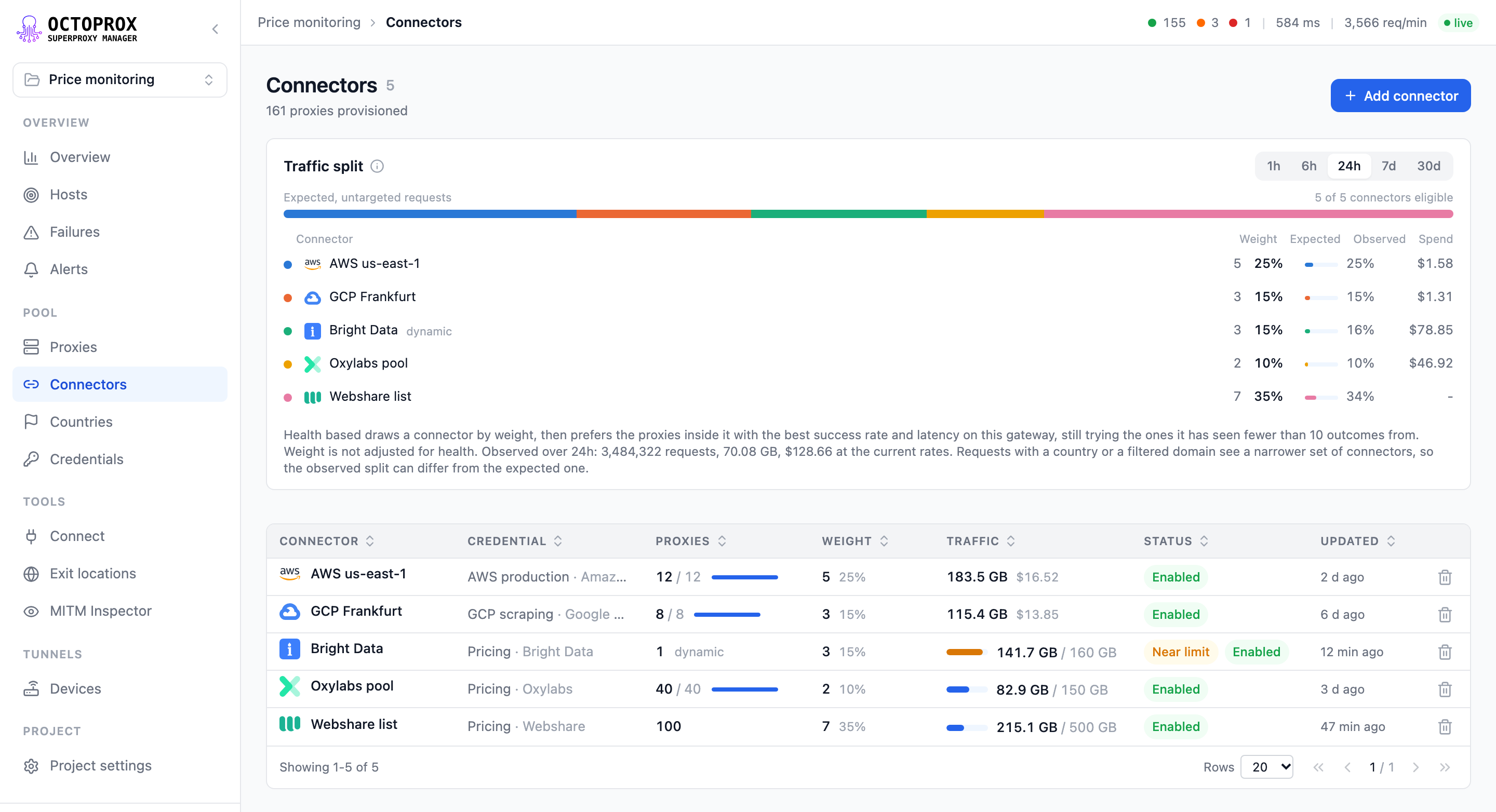
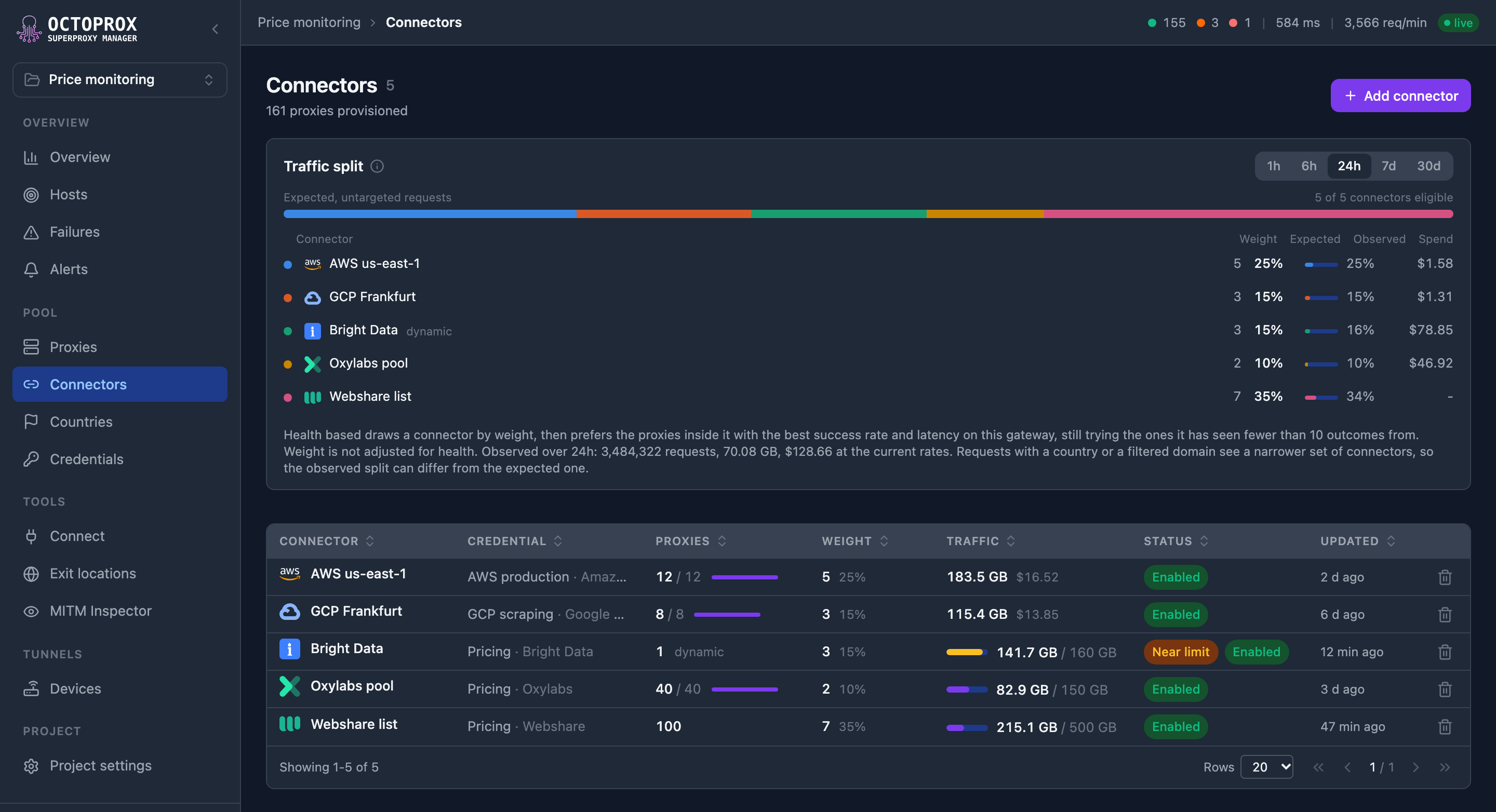
The Connectors page: AWS us-east-1, GCP Frankfurt, Bright Data, an Oxylabs pool and a Webshare list, each with its weight, expected and observed share of traffic, spend and usage against its limit The Connectors page: AWS us-east-1, GCP Frankfurt, Bright Data, an Oxylabs pool and a Webshare list, each with its weight, expected and observed share of traffic, spend and usage against its limit
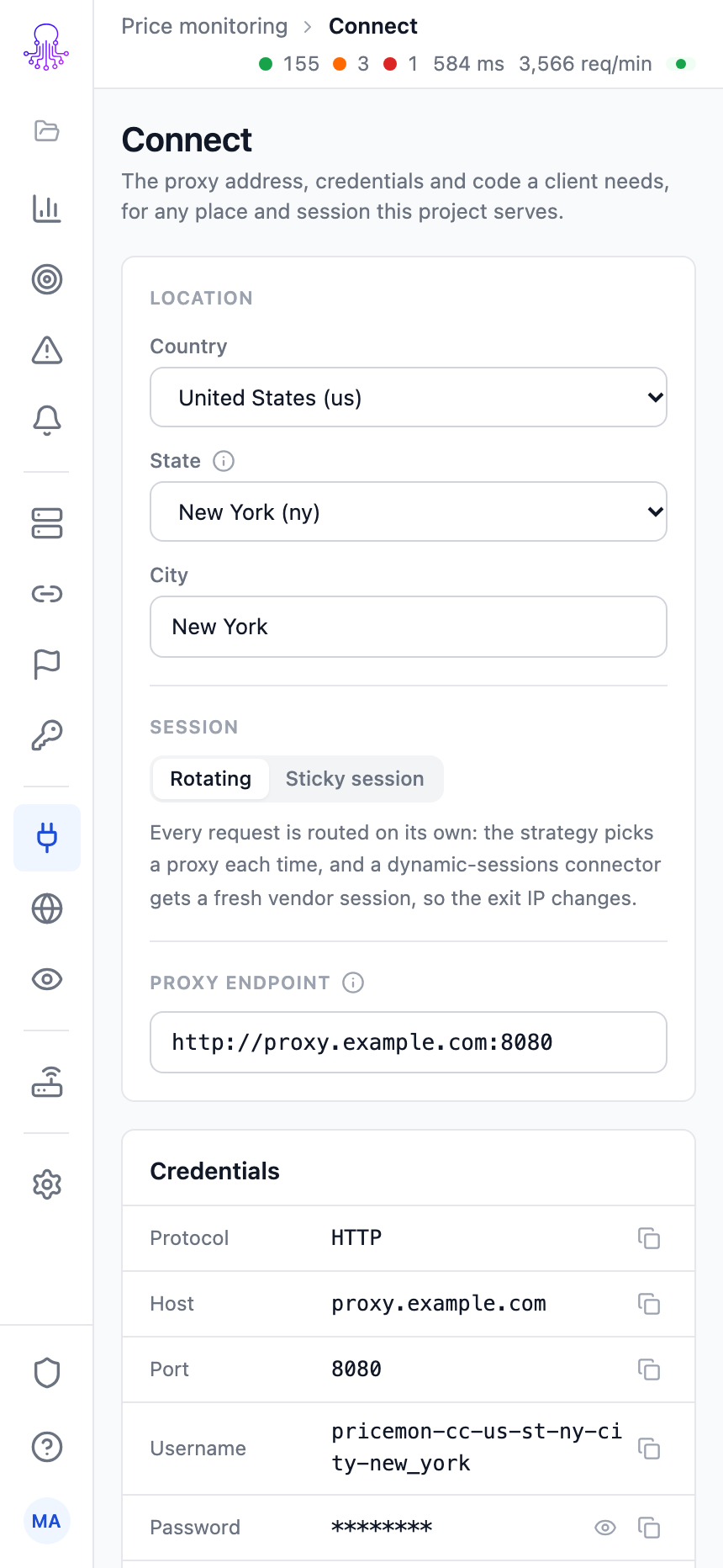
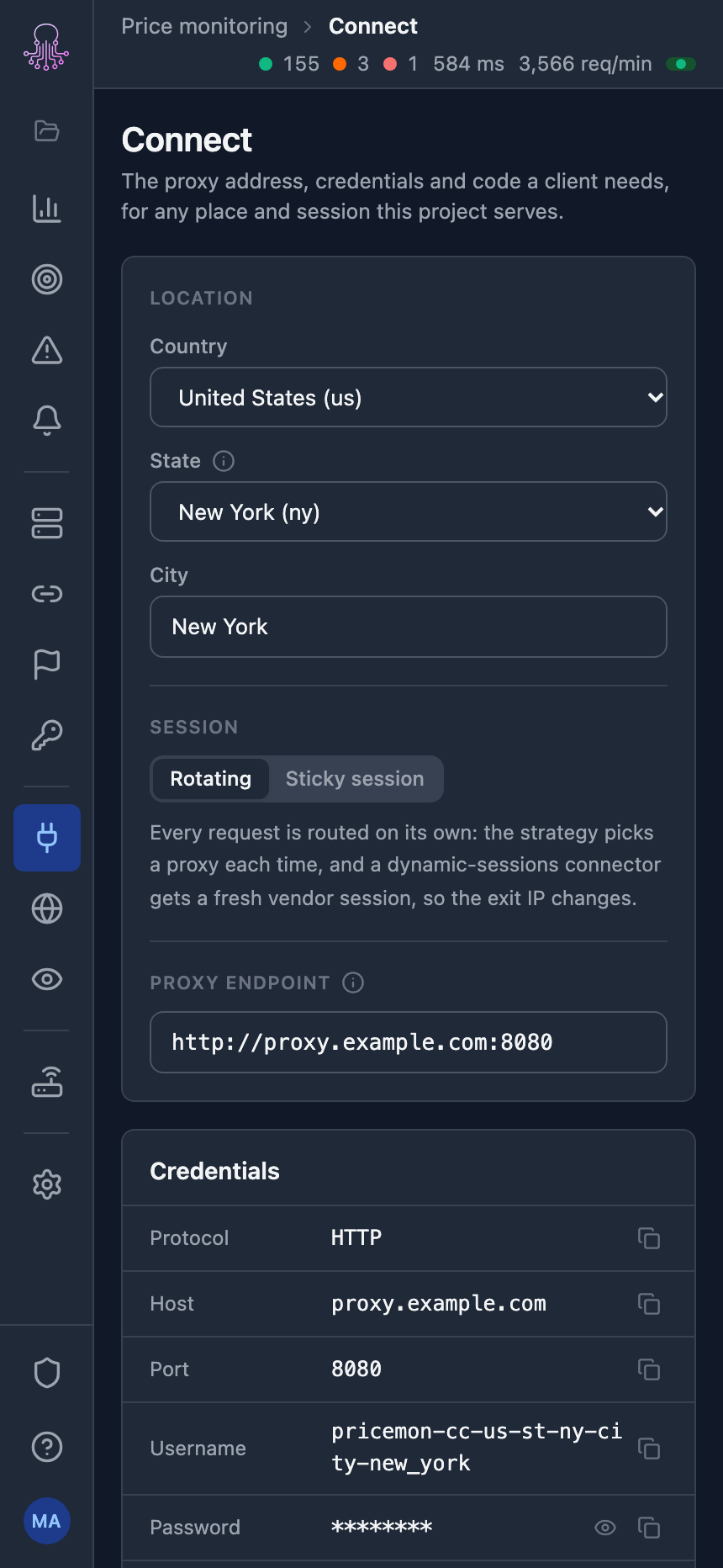
The Connect page on a phone: country, state and city pickers and the session choice for the proxy username The Connect page on a phone: country, state and city pickers and the session choice for the proxy username
Connectors: weights, the expected and observed split, spend and usage against each limit.
Per request
A country, state, city or sticky session, named in the proxy username. Octoprox never silently falls back to another country.
Health checks
Once a minute by default. Failing proxies leave rotation and come back on their own once they pass again.
Per connector
Reserved and excluded countries, domain allow or block lists, and per-proxy rate limits.
Learn more about routing

02 Verify

Check where the exits really are

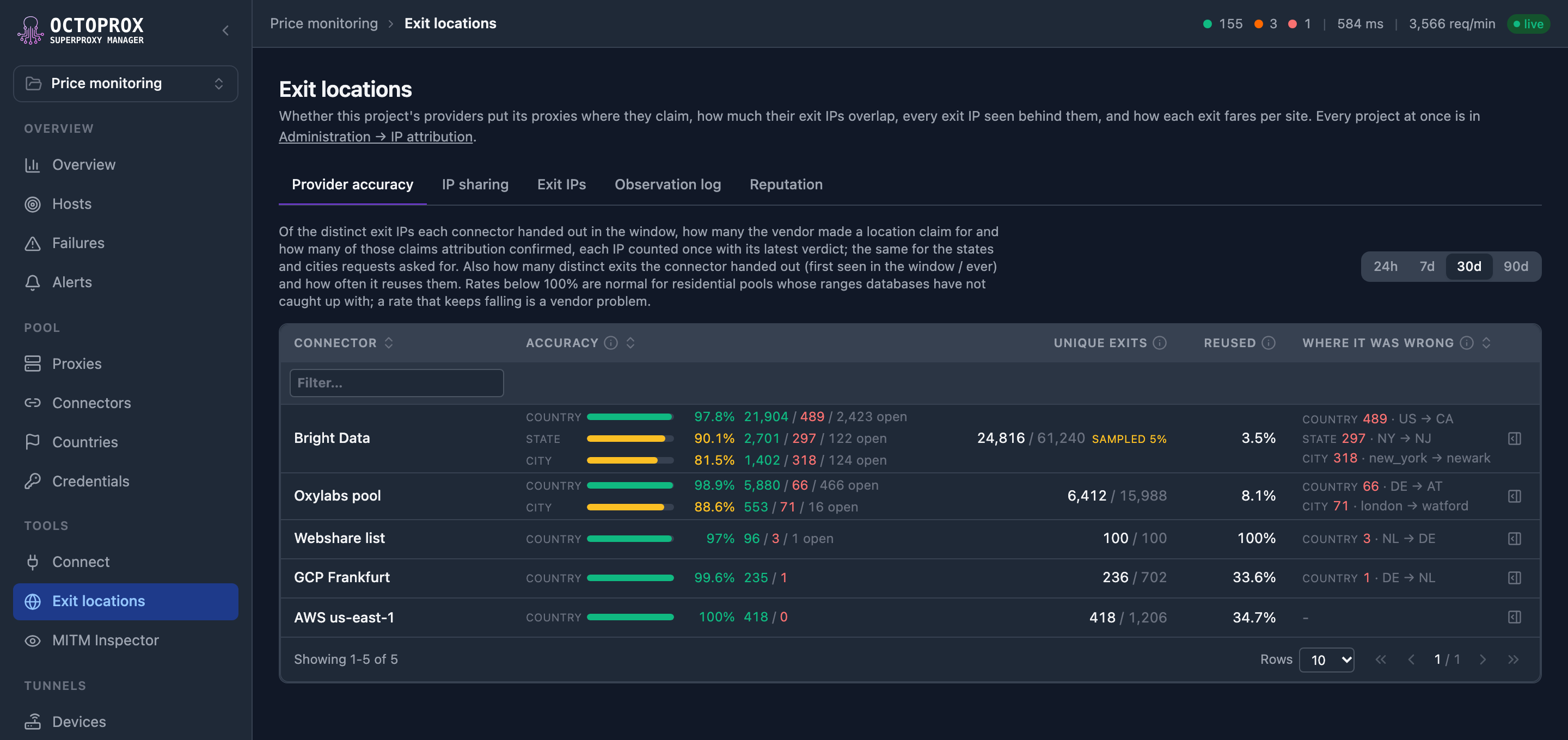
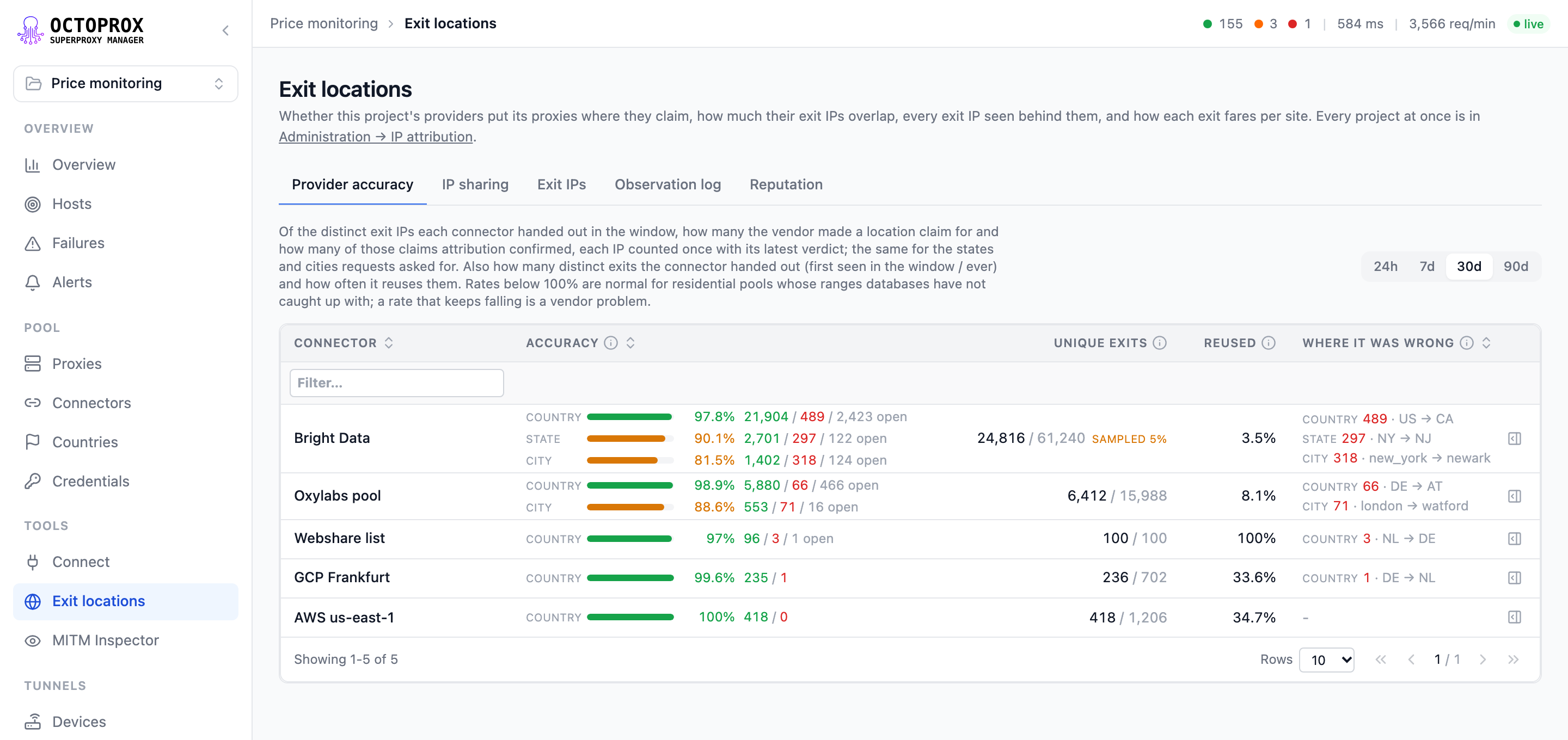
An exit's location comes from IP databases you host (MaxMind, DB-IP, IPinfo or IP2Location) before the vendor's claim. Each claim is confirmed, contradicted or left open, at country, state and city.

The Exit locations page: each provider's accuracy at country, state and city, its unique and reused exit IPs, and where its claims were wrong, such as US claimed and CA found The Exit locations page: each provider's accuracy at country, state and city, its unique and reused exit IPs, and where its claims were wrong, such as US claimed and CA found
Exit locations: how often each provider's exits are where the vendor claims.
Your policy
Per project: route on the evidence, trust the vendor, or refuse.
Preflight
Optionally checks a session's exit before its first request.
Per provider
Accuracy, unique exits and IP sharing between connectors.

Learn more about IP attribution

03 Meter

See what every pool costs, and choose what happens at a cap

Bytes are metered while transfers run, per connector, per day, week or month. A price per GB shows usage as spend.

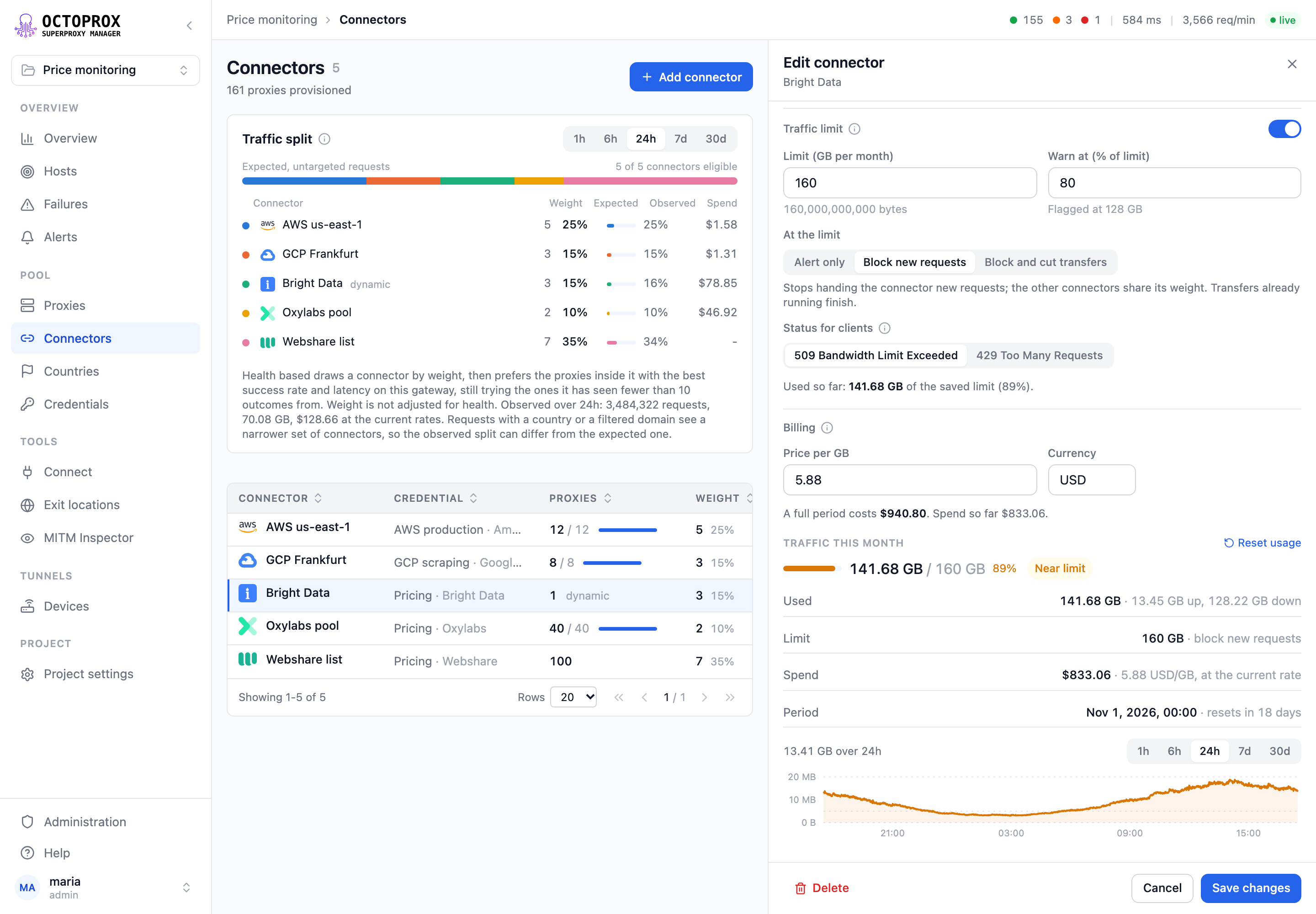
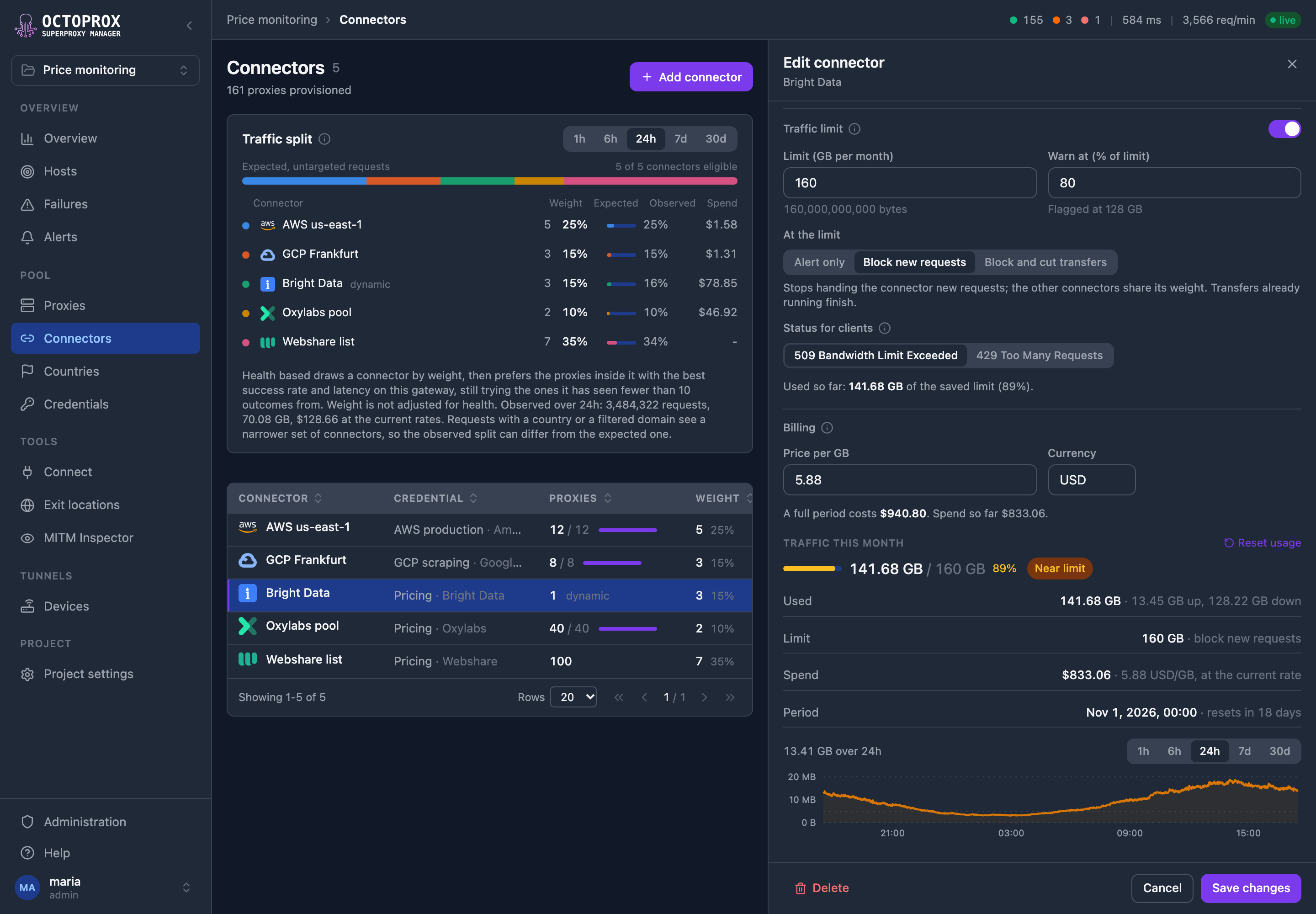
A Bright Data connector's traffic limit of 160 GB a month, set to block new requests at the limit, with a price of 5.88 USD per GB and 141.68 GB used so far A Bright Data connector's traffic limit of 160 GB a month, set to block new requests at the limit, with a price of 5.88 USD per GB and 141.68 GB used so far
A connector's traffic limit, the action at the limit and its price per GB.
At the cap
Alert and keep routing (the default), block new requests, or also interrupt running transfers.
Your clients
When every connector that could serve a request is blocked, the client gets 509, or 429 if you set it, with an RFC 9209 Proxy-Status header.
Traffic split
Each connector's expected and observed share of requests.

Learn more about traffic limits

04 Diagnose

Know what failed, and where the time went

Requests, success rate, latency and bytes per proxy, project, connector, tunnel device and destination host, under one time range from 1h to 90d.

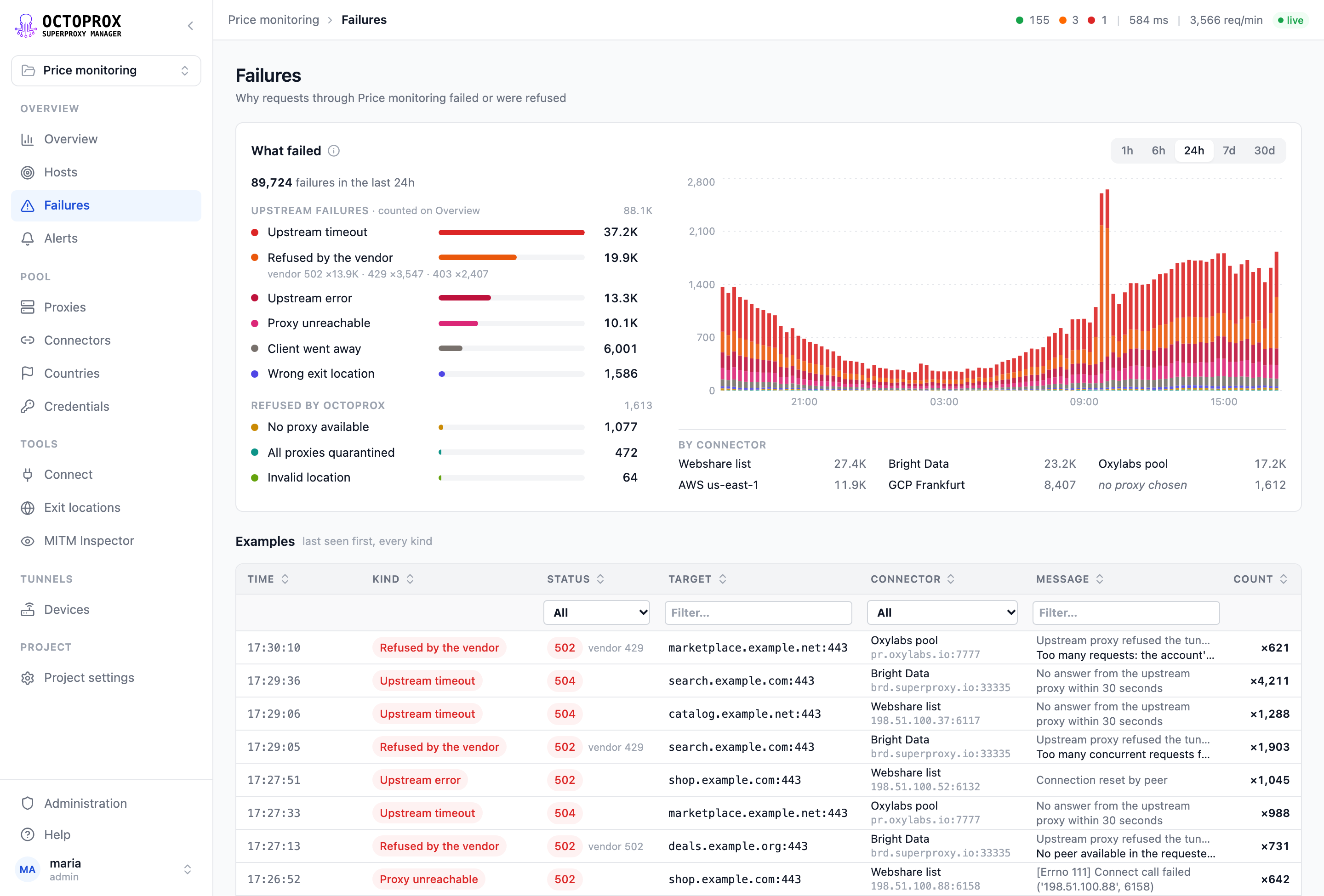
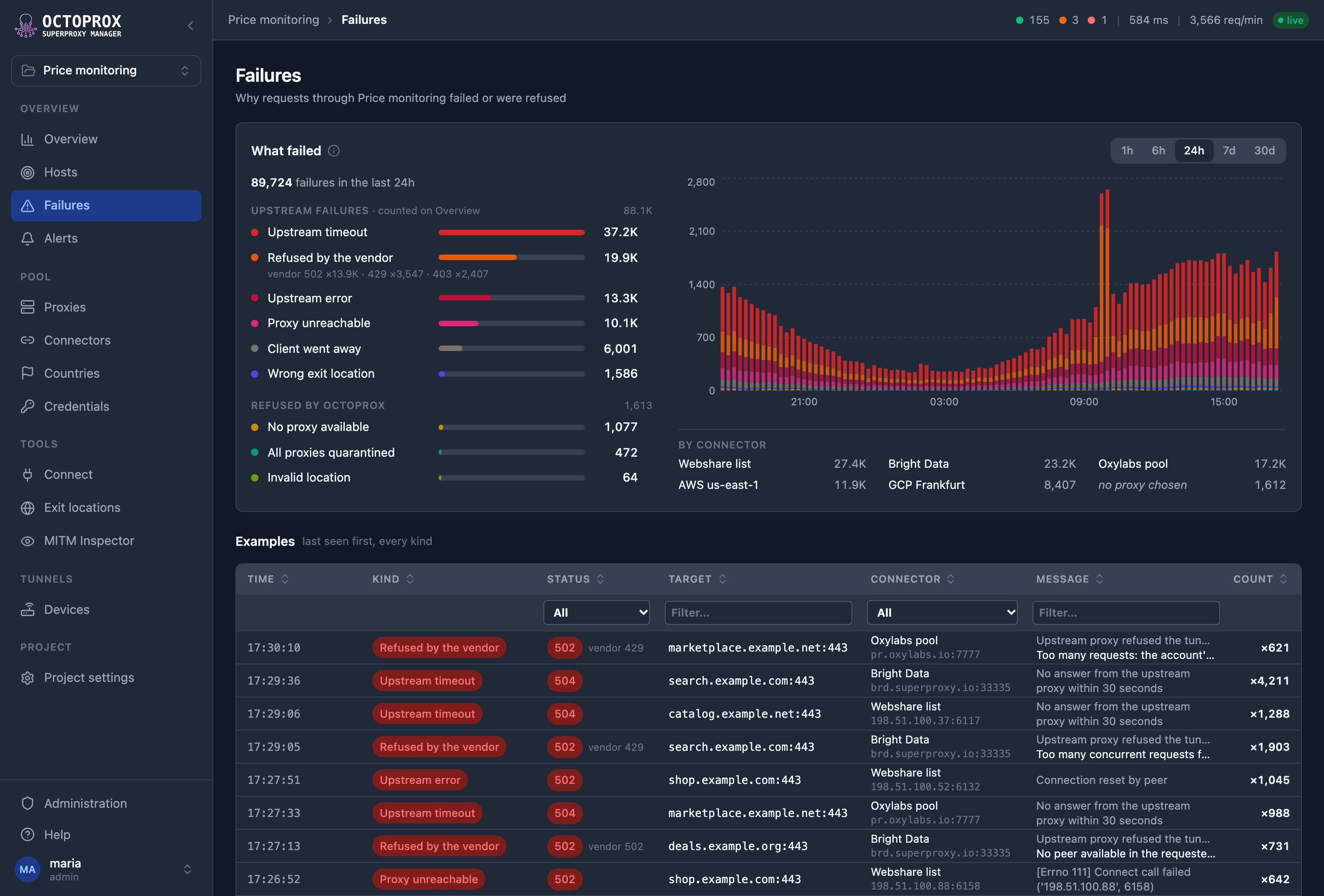
The Failures page: 89,724 failures in 24 hours by kind, such as upstream timeouts and vendor refusals with their status codes, over time and by connector The Failures page: 89,724 failures in 24 hours by kind, such as upstream timeouts and vendor refusals with their status codes, over time and by connector
Failures: why requests failed over 24 hours, by kind, vendor status and connector.
Failures
By kind, vendor status and connector, with the vendor's own answer.
Latency
Split into routing, preflight, connect, handshake and response: Octoprox's time apart from the vendor's.
Prometheus
Metrics per project and per process. Every API request carries an X-Request-ID that each of its log lines names.

Learn more about metrics

Editions

Two editions, one release

Both run the same proxy layer and record who changed what. Octoprox Enterprise adds who got in, under a license that never locks anyone out.

Free Apache 2.0 core

Octoprox

Proxy routing, providers, IP attribution, tunnel devices, metrics and the dashboard, with sign-in, API tokens and a record of every change.

Traffic split of a project's five connectors on AWS, Google Cloud, Bright Data, Oxylabs and Webshare, with each one's weight, expected and observed share, and spend Traffic split of a project's five connectors on AWS, Google Cloud, Bright Data, Oxylabs and Webshare, with each one's weight, expected and observed share, and spend
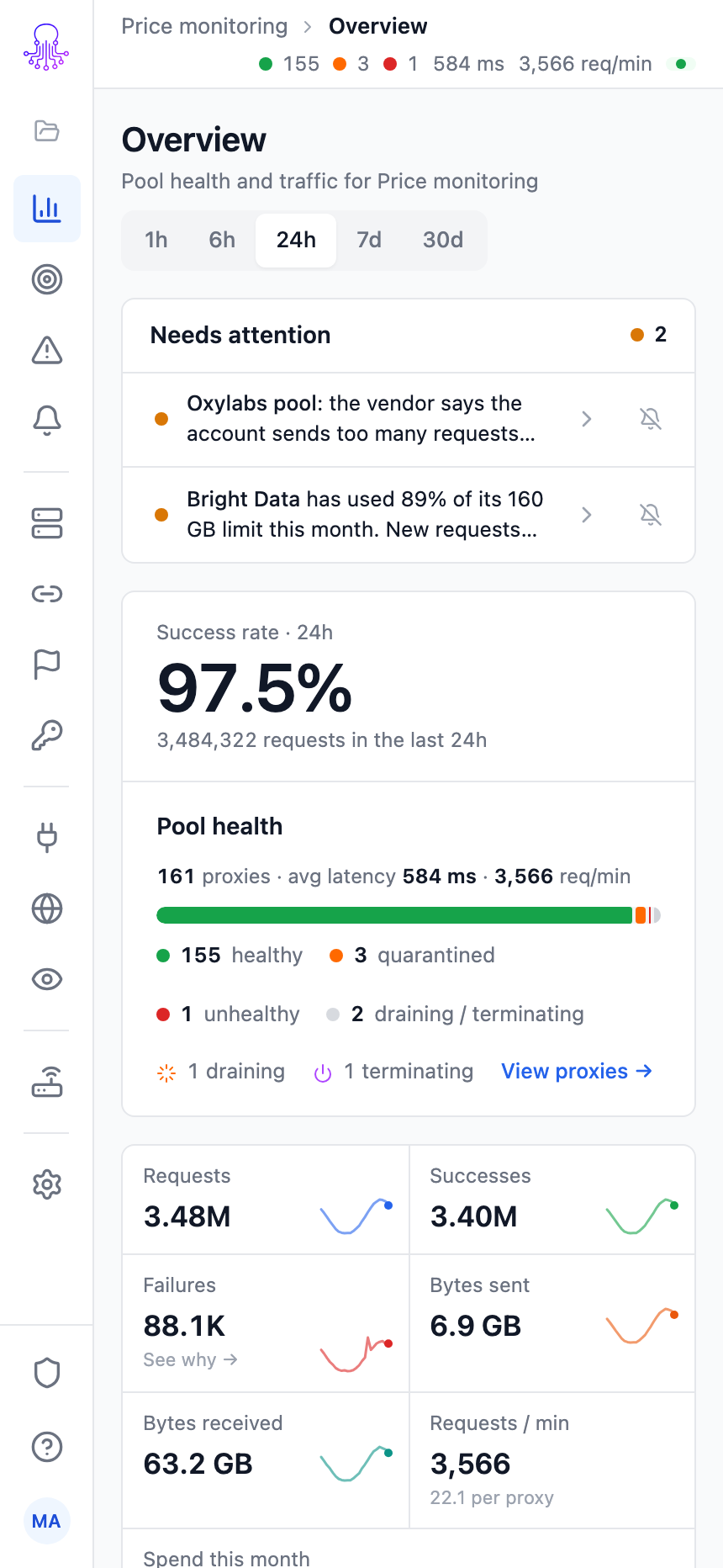
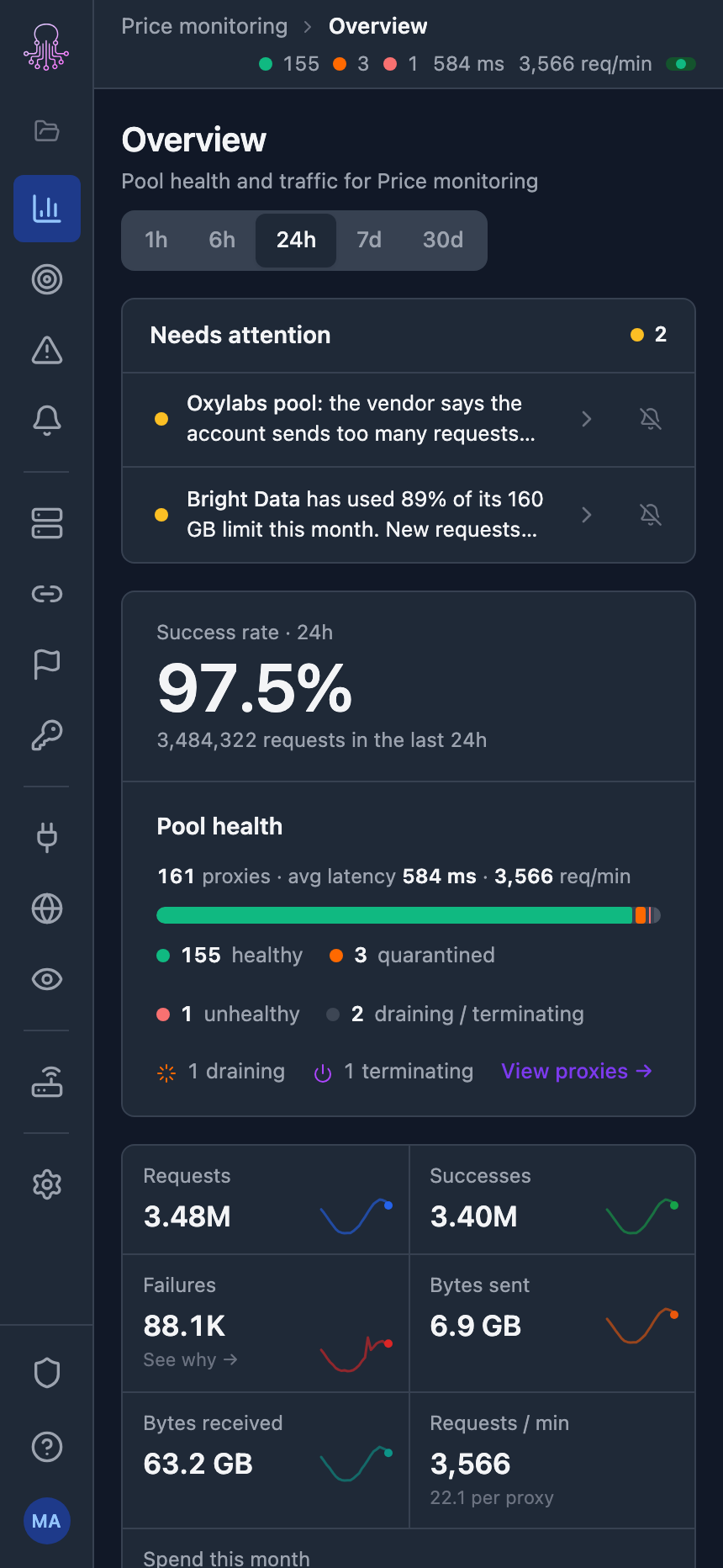
A project's Overview on a phone: 3.48M requests, 3.40M successes and 88.1K failures, 6.9 GB sent, 63.2 GB received and 3,566 requests a minute A project's Overview on a phone: 3.48M requests, 3.40M successes and 88.1K failures, 6.9 GB sent, 63.2 GB received and 3,566 requests a minute
Licensed Same release, its own image

Octoprox Enterprise

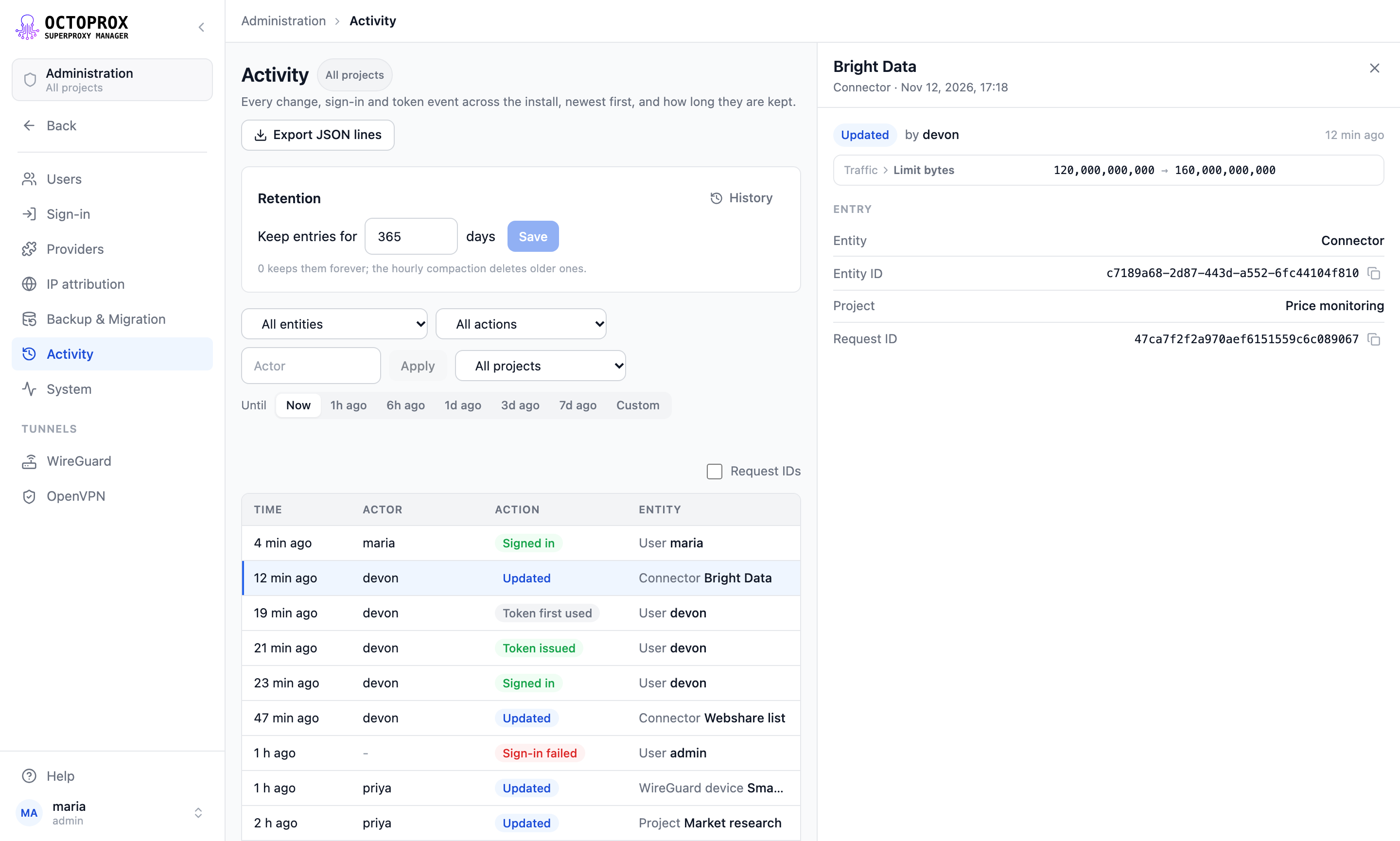
Everything in Octoprox, plus a record of who got in: every sign-in and API token in the audit log, across the whole install, ready for your SIEM.

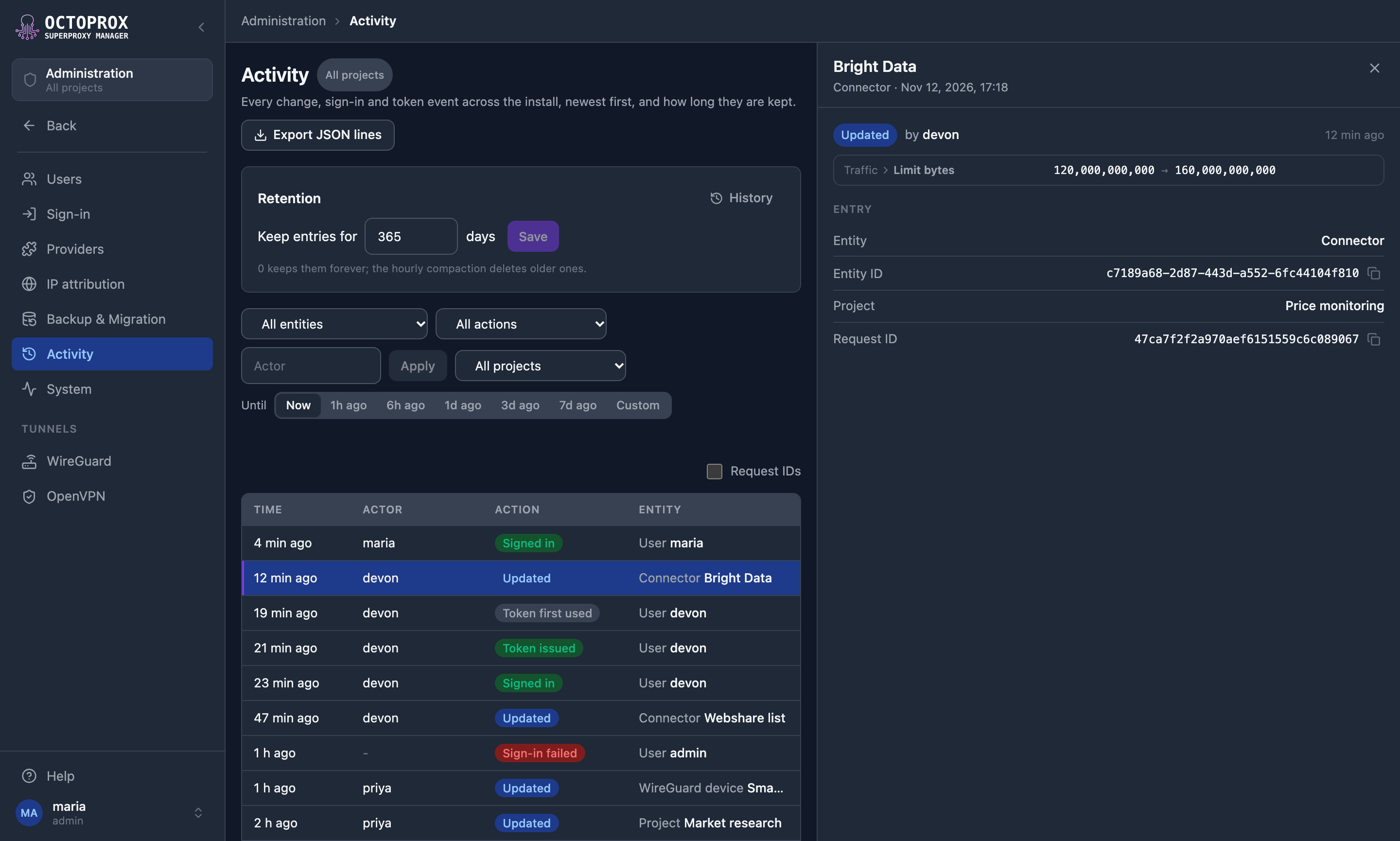
The Activity page of Octoprox Enterprise: sign-ins, a failed sign-in, an API token issued and first used, and changes to connectors The Activity page of Octoprox Enterprise: sign-ins, a failed sign-in, an API token issued and first used, and changes to connectors

Planned For Enterprise: domain rules, your own identity provider, group sync, enforcement and provisioning.

Screens from the product, with demo data.

Works with

Every kind of pool behind one endpoint

You bring the cloud and vendor accounts. Octoprox provisions the instances, checks the proxies and meters every pool.

Cloud instances

Provisioned on demand, scaled on request rate and rotated. Run on that cloud, Octoprox can use the host's identity and store no key.

AWS Google Cloud Azure

Provider sessions

A fixed pool, or dynamic: a vendor session per request.

Bright Data Oxylabs Decodo Beta Webshare Beta IPRoyal Beta NetNut Beta

Static lists

Your own proxies over http, https, socks4 or socks5, health-checked and routed like the rest.

Static list

Custom providers

Any other vendor, added as a YAML descriptor from the admin UI, with no code or redeploy. A vendor that needs code can come as a Python plugin.

Learn more about providers
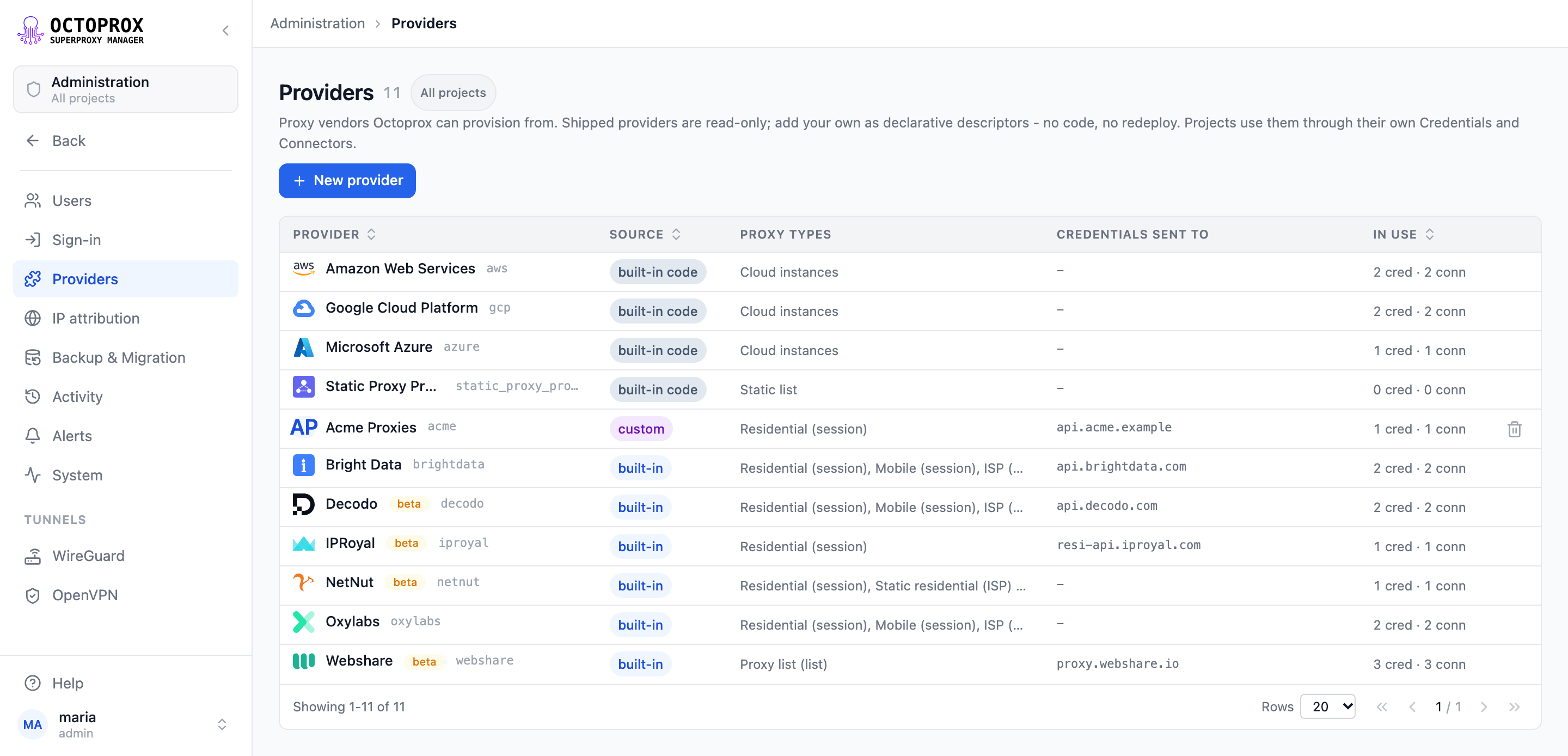
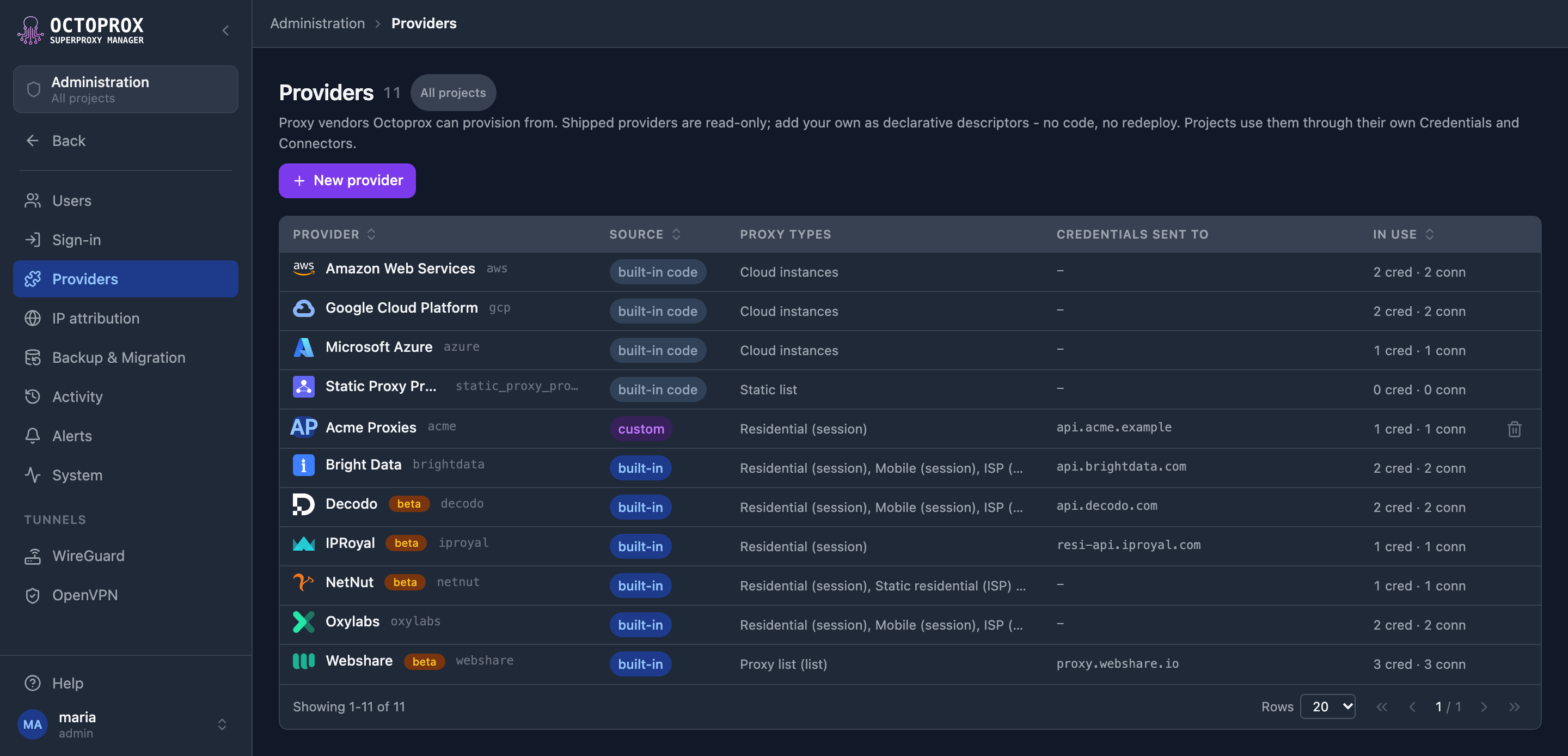
The Providers page: Acme Proxies, added from the admin UI, marked custom among built-in providers such as Amazon Web Services and Bright Data The Providers page: Acme Proxies, added from the admin UI, marked custom among built-in providers such as Amazon Web Services and Bright Data

And for devices

No proxy settings? Join through a tunnel

Phones, TVs, consoles and routers join a project through a WireGuard or OpenVPN tunnel, and their connections go out through the pool.

WireGuard 51820/udp OpenVPN 1194, UDP or TCP
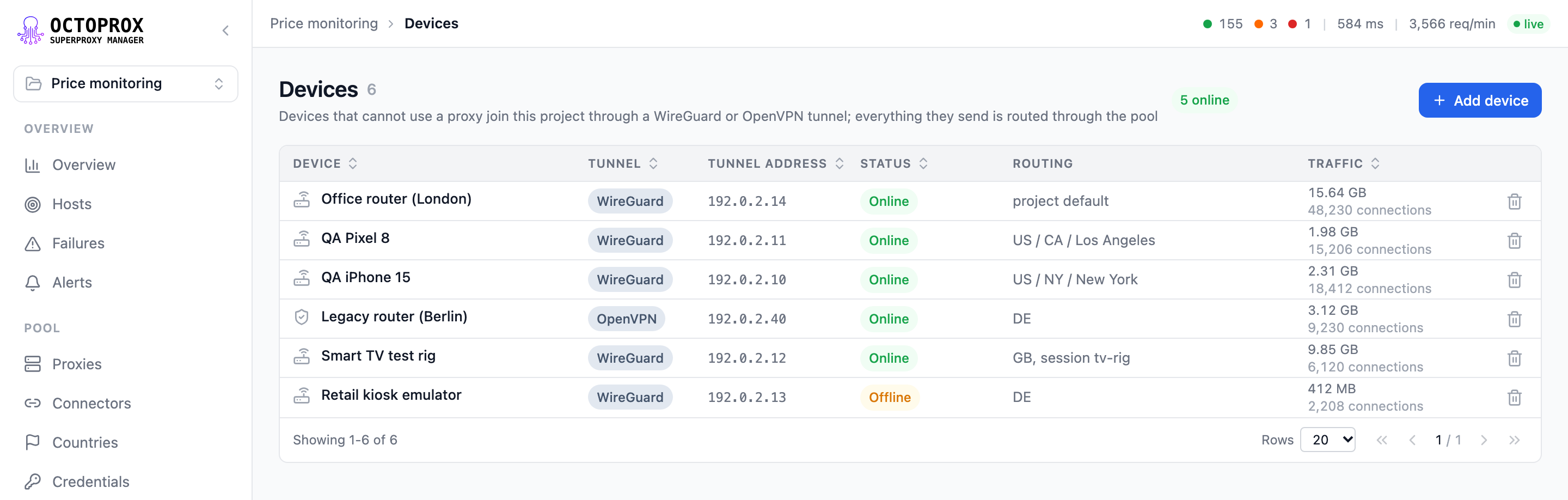
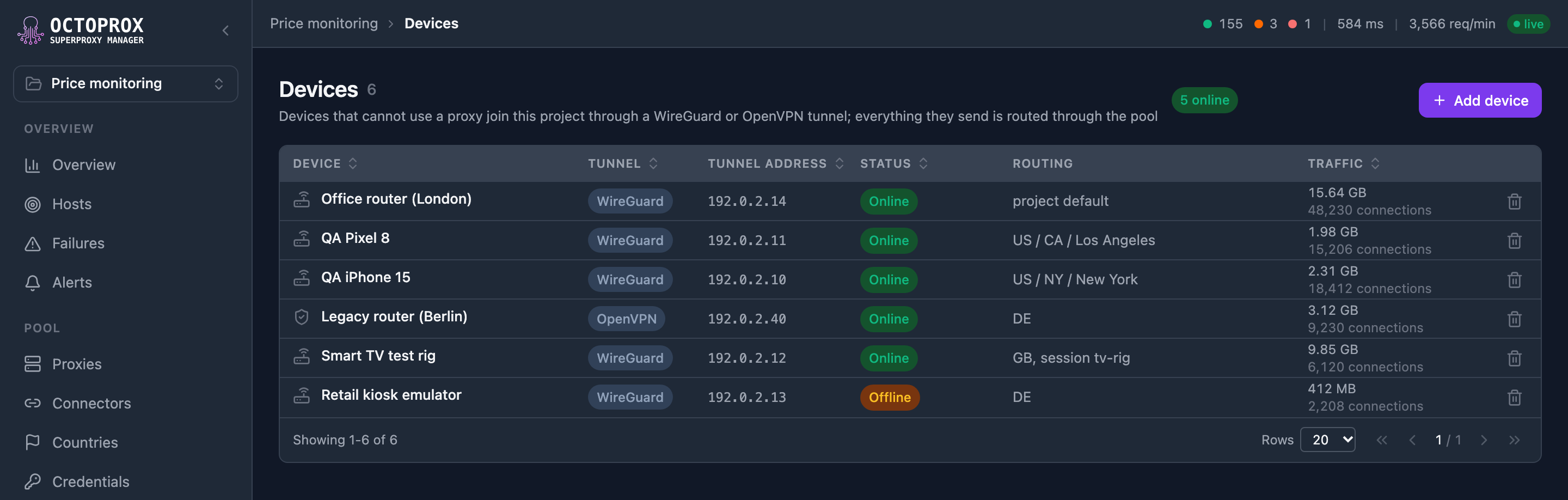
The Devices page: phones, a TV rig and routers on WireGuard and OpenVPN tunnels, each with its tunnel address, status and routing, such as US, NY, New York The Devices page: phones, a TV rig and routers on WireGuard and OpenVPN tunnels, each with its tunnel address, status and routing, such as US, NY, New York

Quick start

Running in two commands

One process from the pre-built image, with Postgres and Redis beside it, for development, demos and small production installs.

Single instance
# Run a single instance with the pre-built image$curl -O https://raw.githubusercontent.com/octoprox/octoprox/main/docker-compose.ghcr.yml$docker compose -f docker-compose.ghcr.yml up -d --remove-orphans

Web UI on localhost:8000, proxy on localhost:8080. Default login admin / admin.

Then

Point a client at it

Each project's Connect page builds the username for any place and session, the proxy URL, and code to copy for curl, Python, Node.js, Playwright and environment variables.

Migrating

Coming from Scrapoxy?

The migration guide maps every Scrapoxy setting to Octoprox, and a typical setup takes well under an hour. Any vendor Octoprox does not ship can be added as a YAML descriptor, with no code or redeploy. Scrapoxy itself was discontinued in February 2026 after eleven years: images removed, docs offline, the shared GeoIP and health-check backend switched off.

Read the migration guide
What a Scrapoxy setting becomes in Octoprox
ScrapoxyOctoprox
Project tokenUsername and password
Cookie sessions-sessid- in the username
Port 8888Port 8080